INFANT SAFE SLEEP
Safe Sleep Environment for Baby
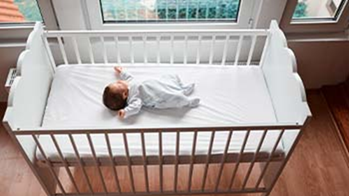 A safe sleep area can help reduce baby’s risk for Sudden Infant Death Syndrome (SIDS) and other sleep-related deaths, such as from accidental suffocation.
What does a safe sleep environment look like?
A safe sleep environment for baby is:- Firm (returns to its original shape quickly if pressed on)
- Flat (like a table, not a hammock)
- Level (not at an angle or incline) and covered only with a fitted sheet
Why does baby's sleep surface have to be firm, flat, and level?
 Although adults may prefer soft surfaces for sleep, research shows that babies who sleep on top of soft surfaces or with items are at higher risk of SIDS and other sleep-related death. Soft surfaces, like couches, sofas, waterbeds, memory foam, air or pillow-top adult mattresses, quilts, blankets, and sheepskins are not safe for babies to sleep on.
Sleeping under quilts, blankets, sheepskins, and other soft coverings also increases the risk of sleep-related infant death from suffocation and strangulation.
Sleep surfaces with one end higher than the other are not safe for babies to sleep on, because baby's body can slide down and their head can slump forward. This can cause positional asphyxia, which is when baby's body position gets in the way of their breathing.
Similarly, sleep surfaces that elevate both baby’s head and feet, like a hammock, also increase the risk for positional asphyxia. Sitting with the head down and the chin on or near the chest could block baby’s airway and cause suffocation.
For these reasons, baby's sleep surface should be firm (returns to its original shape quickly if pressed on), flat (like a table, not a hammock), and level (not at an angle or inclined).
Although adults may prefer soft surfaces for sleep, research shows that babies who sleep on top of soft surfaces or with items are at higher risk of SIDS and other sleep-related death. Soft surfaces, like couches, sofas, waterbeds, memory foam, air or pillow-top adult mattresses, quilts, blankets, and sheepskins are not safe for babies to sleep on.
Sleeping under quilts, blankets, sheepskins, and other soft coverings also increases the risk of sleep-related infant death from suffocation and strangulation.
Sleep surfaces with one end higher than the other are not safe for babies to sleep on, because baby's body can slide down and their head can slump forward. This can cause positional asphyxia, which is when baby's body position gets in the way of their breathing.
Similarly, sleep surfaces that elevate both baby’s head and feet, like a hammock, also increase the risk for positional asphyxia. Sitting with the head down and the chin on or near the chest could block baby’s airway and cause suffocation.
For these reasons, baby's sleep surface should be firm (returns to its original shape quickly if pressed on), flat (like a table, not a hammock), and level (not at an angle or inclined).
Can I put a pillow, blanket, or a favorite toy in baby's sleep area?
Even though a crib with nothing in it except a fitted sheet covering the mattress may seem bare, it is the safest option for baby. Things in the sleep area can pose dangers for baby, especially if they are:- Soft or squishy (e.g., pillows, stuffed toys, crib bumpers)
- Under or on top of baby (e.g., comforters, quilts, blankets, positioners)
- Non-fitted, even if they are lightweight, small, or "tucked in" (e.g., loveys/cloths, non-fitted sheets, tucked-in blankets)
- Weighted (e.g., weighted blankets, weighted swaddles)